There is a phrase that comes up repeatedly in conversations about Lynn’s economic trajectory: Gateway City. Designated as one of 26 such cities in Massachusetts, Lynn is defined by the state as a midsize urban center that anchors its regional economy while facing persistent challenges in household income and educational attainment. It is not always a flattering label, but city officials and economic development professionals have increasingly found ways to turn it into an asset.
Located less than four miles from downtown Boston, Lynn offers something that the surrounding suburbs and the city itself cannot always provide: affordability. Commercial rents in Lynn’s downtown and emerging waterfront districts remain substantially lower than comparable spaces in Cambridge, Somerville, or Boston proper, making the city an increasingly attractive option for small business owners, creative entrepreneurs, and light industrial tenants who need proximity to the metro area without the metro area price tag.
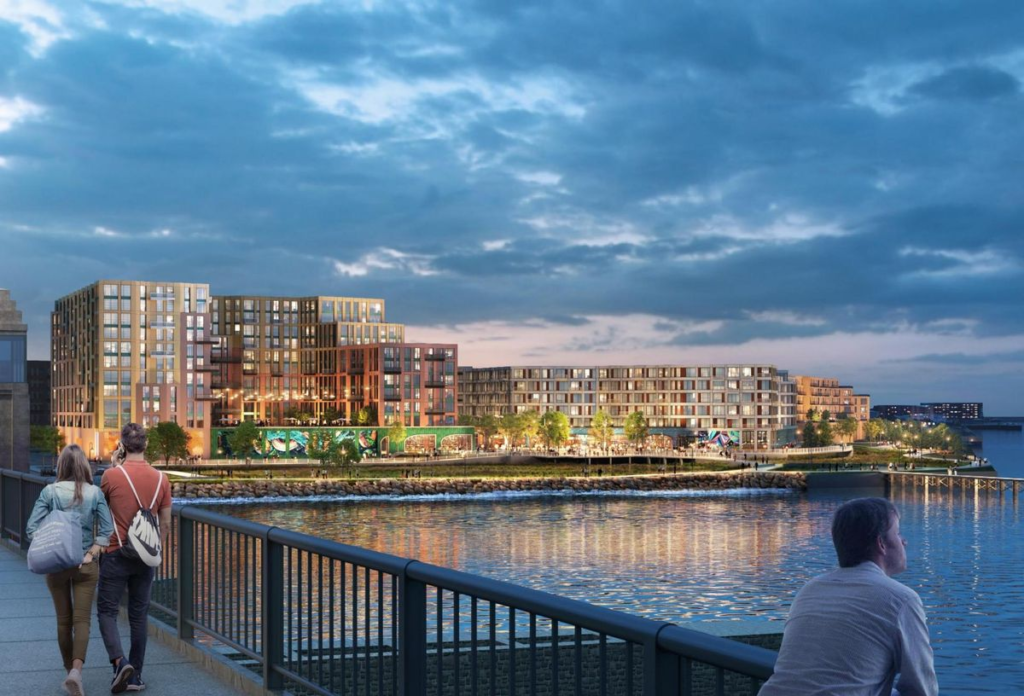
The Economic Development and Industrial Corporation of Lynn (EDIC) has been the city’s primary engine for business attraction and retention for more than four decades. Its mandate is to transform the waterfront and downtown district into what it describes as ‘bustling, pedestrian-friendly destinations’ — a vision that has moved from aspiration to active construction in recent years. The EDIC provides financing to businesses operating within Lynn’s commercial districts, helps connect entrepreneurs with city and state resources, and works to recruit new tenants to high-potential spaces like the former J.B. Blood Building.
The North Shore Latino Business Association and organizations like EforAll Lynn and its Spanish-language counterpart EparaTodos Lynn have become important nodes in the city’s business support ecosystem. Given that Lynn’s business community is significantly shaped by immigrant entrepreneurs — a walk through downtown reveals storefronts in Spanish, Portuguese, Khmer, and several other languages — these organizations play a practical role in making resources accessible to business owners who might otherwise navigate city and state systems alone.
Lynn’s transportation infrastructure is a meaningful economic asset. The Lynn Commuter Rail station on the MBTA’s Newburyport/Rockport Line connects the city to North Station in Boston in roughly 30 minutes, making it viable for residents to live in Lynn and work in the city — or for businesses in Lynn to draw employees from across the region. Bus connections through the MBTA network extend that reach further.
The healthcare sector also anchors a portion of Lynn’s employment base. Lynn Community Health Center, which has seen expansion in recent years, serves as both a healthcare provider and a significant employer in a city where access to primary care has historically been uneven. Investment in the health center reflects a broader recognition that workforce health and community wellbeing are inseparable from economic development.
Looking ahead, the question for Lynn is not whether growth is coming — it clearly is — but whether the city can manage that growth in a way that preserves what makes it distinctive. The South Harbor Implementation Plan, which the city has been developing with extensive community input, reflects an attempt to answer that question intentionally rather than reactively. With a new comprehensive master plan in place, an active redevelopment pipeline, and a business community that spans dozens of nationalities and industries, Lynn enters 2026 with more economic momentum than it has seen in a generation.
The old rhyme that gave Lynn a dismissive reputation belongs to another era. The city being built today — on its waterfront, in its cultural district, and through its community organizations — is writing a new story.